
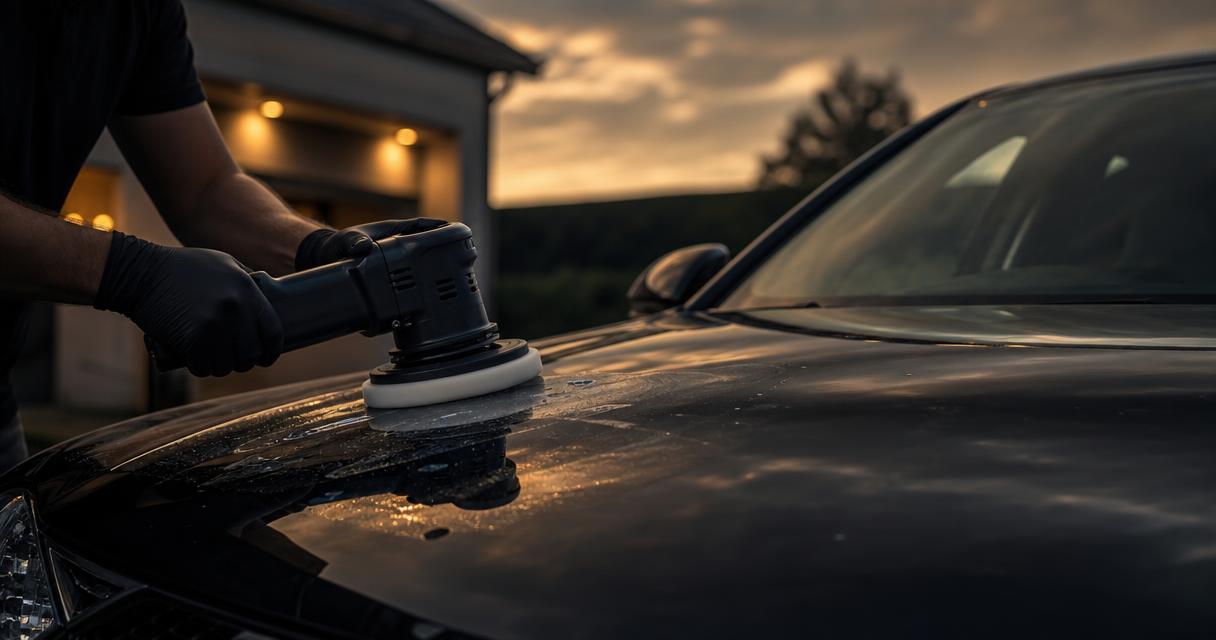
What 'car buffing' actually means
In everyday language, buffing is anything that makes a car look glossy. To a detailer, buffing is a cutting or polishing step done with a machine and an abrasive compound to level the clear coat and remove defects like swirl marks, light scratches, oxidation, and water-spot etching.
The key distinction is that buffing actually removes a tiny amount of clear coat — usually measured in microns — to reveal fresh, reflective paint underneath. It is not waxing. Wax adds a layer on top; buffing takes material away.
- Wax or sealant: adds gloss and protection on top of the paint. Does not remove defects.
- Buffing / polishing: removes or reduces defects by leveling the clear coat.
- Paint correction: the full process of compounding, polishing, and finishing to restore clarity.
What a professional buffing service includes
A proper buffing service doesn't start with the machine. It starts with a wash and decontamination, because running a polisher over bonded iron or tree sap will drag those particles across the paint and make it worse.
- Deep clean and decontamination wash (iron remover, tar remover, clay bar if needed).
- Paint inspection under LED or sunlight to map defects and measure clear-coat thickness.
- Tape off trim, emblems, and rubber to protect edges from polish residue.
- Cutting or compounding stage with a rotary or dual-action polisher to remove defects.
- Finishing polish to refine clarity and remove any haze left by the compound.
- Wipe down with isopropyl alcohol to remove polishing oils and inspect the result.
- Optional: protection layer such as wax, sealant, or ceramic coating.
When your car actually needs buffing
- The paint looks hazy or dull even after washing.
- Swirl marks are visible in direct sunlight or under garage lights.
- Light scratches, scuffs, or water spots have etched into the clear coat.
- You're about to apply ceramic coating or a long-term sealant and want the surface corrected first.
- You're selling the car and want the paint to present well without a full repaint.
If the scratch is deep enough to catch a fingernail, it has likely gone through the clear coat. Buffing won't remove it completely — that needs touch-up paint or a respray.
What a car buffing service costs
Pricing depends on vehicle size, paint condition, and whether the job is a single-stage polish or a full paint correction. A mobile service usually bundles the work with a detail so you're not paying shop overhead for a single step.
- Single-stage polish (light haze, minor swirls): $150–$300 on a sedan, slightly more on SUVs and trucks.
- Two-stage paint correction (compounding + finishing): $400–$800 depending on size and defect severity.
- Full correction on neglected or dark paint: $800–$1,500+.
- Add ceramic coating: $500–$1,200+ depending on the coating's rated lifespan.
FujiWash™ quotes buffing and paint correction flat based on your photos and the vehicle size, and we handle the work at your driveway so you don't lose a day at the shop.
DIY buffing vs. hiring a detailer
A dual-action polisher and a bottle of compound are easy to buy. The skill is knowing how much clear coat you have left, how aggressive a pad you can use, and when to stop. Most DIY paint damage happens because the polisher is run too long on one spot or with the wrong pad for the paint hardness.
- DIY is fine for very light haze on a daily driver you plan to keep long-term.
- Hire a pro if the car has hard paint, dark or metallic finish, deep defects, or thin clear coat.
- Hire a pro if you're coating the car afterward — coating locks in whatever is under it.
How long it takes
A single-stage polish on a sedan takes two to three hours in a controlled setting. A full two-stage correction can take a full day. Mobile services add setup and breakdown time for generators, water, and lighting, but you avoid the drop-off and pick-up overhead of a shop.
FAQ
- What does a car buffing service do?
- A professional buffing service uses a machine polisher and abrasive compound to remove a microscopic layer of clear coat, leveling out swirl marks, light scratches, oxidation, and water-spot etching to restore gloss.
- Is buffing the same as waxing?
- No. Buffing removes clear-coat material to correct defects. Waxing adds a protective layer on top of the paint. Buffing comes first; waxing or sealing comes after.
- How much does it cost to get a car buffed?
- A single-stage polish typically runs $150–$300 for a sedan, while a full two-stage paint correction is $400–$800 or more for SUVs and trucks with severe defects. Ceramic coating is usually added separately.
- Can buffing remove deep scratches?
- Only if the scratch is within the clear coat. If you can catch the scratch with a fingernail, it has likely gone through the clear coat and buffing won't remove it completely — that needs touch-up paint.
- How long does car buffing take?
- A single-stage polish takes about two to three hours on a sedan. A full correction can take four to eight hours or more. Larger vehicles and harder paint add time.
- How often should you get your car buffed?
- Most cars only need paint correction every two to three years, or once before a ceramic coating. Over-buffing removes too much clear coat, so it should be done only when defects are visible.